


WS Amati Strategic Metals Fund: What a difference a week makes!
By Georges Lequime, Fund Manager, WS Amati Strategic Metals Fund
3 February 2026
Following a sharp correction in gold and silver prices, Georges Lequime, Fund Manager of the WS Amati Strategic Metals Fund, looks at what drove the recent volatility and what it could mean for precious metals and mining companies.
While short-term moves in gold and silver remain difficult to predict, Georges Lequime argues that the longer-term forces supporting metals remain structural, including central bank gold buying, supply constraints, years of underinvestment in new mine supply and growing demand for strategic resources.
Download the article here here
What a difference a week makes!
On Thursday and Friday last week, the gold price dropped US$1,000/oz and the silver price shed US$45/oz, sending panic among investors and speculators who arrived late to the trade.
Trying to make sense of the dramatic moves in gold and silver last week is difficult and we don't profess to have any better insights than anybody else. We wrote the same during the parabolic move upwards that we witnessed over the preceding two weeks. We felt then that the shares were not following through (market suspicion about the sustainability of the very sharp move) and that a correction was due. Gold and silver prices need to stabilise before investors have any confidence about the investment opportunity in the underlying companies - irrespective of how cheap they appear!
The facts that we do know for sure is that there was an options expiry for gold and silver February futures on Tuesday, January 27, and then Friday, January 29, was the First Notice Day for February futures contracts for gold and silver. On top of this, on Tuesday, January 27, COMEX announced that it would increase margin calls in silver futures contracts from 9% to 11%. In China, regulators halted trading of five leading commodity funds on Friday. We have been hearing and reading about a huge amount of stress in the derivatives market in the weeks and months leading up to last Thursday, so this major swing due to the unwinding of leverage was perhaps to be expected. Trump's appointment of a new FED Chairman seems more coincidental rather than a cause of the major swing in prices. The appointment of a more hawkish Fed governor should have shook the broader US stock market if the market truly believed that he would meaningfully change current US monetary policy. Clearly, this did not happen (maybe not yet?).
Where do we go from here?
When we look at both the gold and silver markets (and a number of other metals as well), the upward pressure on prices that we have witnessed over the past two years is very much structural in nature, rather than pure speculation. Since 2022, Central Banks around the world have increased their gold purchases substantially. More recently, individual investors turned from sellers to buyers of gold in the form of physical and through the gold ETF (as a result of falling interest rates and seeking a safe haven). This is what has driven the gold price substantially higher in recent months. The volatility will no doubt shake off some investors but Central Bank buying is likely to continue unabated. Foreign governments and central banks are sitting on US$10+ trillion in foreign reserves — most of that parked in US dollars. Their “extra” gold purchases since 2022 (i.e. the amount of gold they bought each year above the historic average) only totals around $100 billion, i.e. roughly ONE PERCENT of their reserves. Central Bank policies do not change overnight and the reasons for diversification away from US treasuries have not changed at all.
The silver market continues to be in a major supply deficit for the foreseeable future. This needs to be ultimately addressed either through a significant increase in supply (very difficult) or demand destruction (possible but it will take a long time and will probably need prices to be 50-100% higher).
What do we do?
The underlying stocks looked very cheap before last Thursday, now they look incredibly cheap. Market peaks are usually accompanied by the stocks being overbought (classic - end of the mania phase). We have not seen this - maybe investors are smarter today. As we write this note, gold stocks are discounting US$3,000-3,500/oz and silver stocks around US$45-55/oz. This implies a relatively large margin of safety for investors. However, given the volatility that we have seen in recent days, we could still get more downswings in the prices of gold and silver over the next few weeks, which will invariably lead to the share prices of the underlying companies coming under pressure again.
The real question is the investment time horizon.
Short-term, we have no idea whether we will go much lower than where we are today over the coming weeks or months. Longer-term, we remain really excited by the prospects of the metals sector and the positioning of the Amati Strategic Metals fund through the upcoming phase of mine development and exploration focus.
There is little doubt in our minds that the volatility that we have seen in nearly all metal prices in recent years is as a result of upcoming and actual supply-demand market imbalances that have resulted from decades of underinvestment in new supply and the acceleration in the deglobalisation of the world economy. The hoarding of metal (esp copper) by both the US and China is introducing a new dynamic to the metals market, which could see more widespread spikes in metal prices in the short-term. History has shown that the real and sustainable gains in commodities are made by investing made during the development and exploration phases that follow price spikes. We feel that we are currently at the onset of this phase.
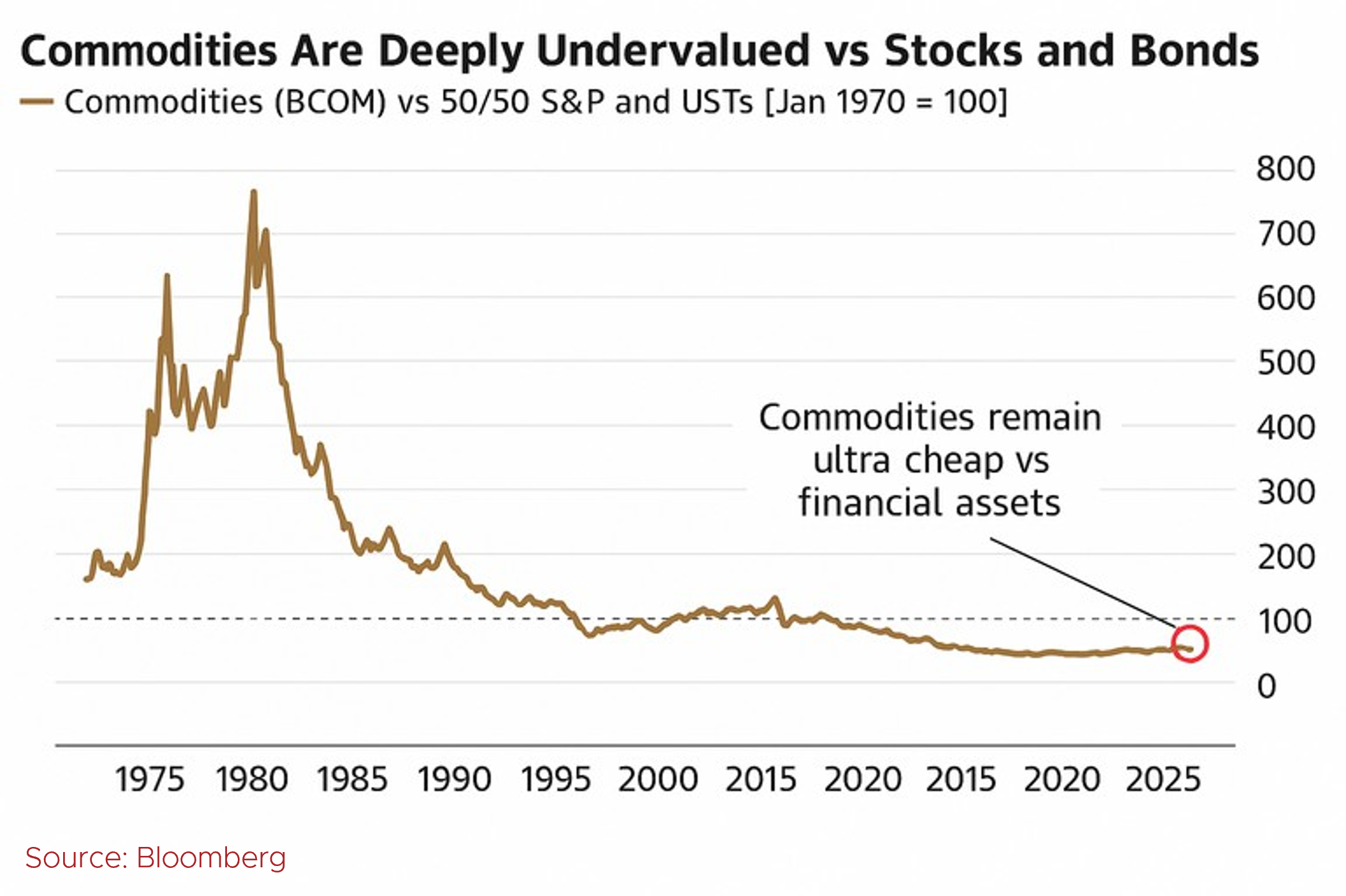
For those who believe that they have missed the commodities trade, the graph below is very telling (up to date as of February 2, 2026). It does not look or feel like a bubble has just burst (as in 1980/81) but rather a start of a rotation into hard assets and commodities.
Risk Warning
Past performance is not a reliable guide to future performance. The value of investments and the income from them may go down as well as up and you may not get back the amount originally invested. Tax rates, as well as the treatment of OEICs, could change at any time. The investments associated with this fund are concentrated in natural resources companies, which means that the fund is subject to greater risk and volatility than other funds with investments across a range of industry sectors. The fund invests in companies that have operations in developing markets and which therefore may be subject to higher volatility due to political, economic and currency instability. Shares in some of the underlying companies in the fund may be difficult to sell at a desired time and price. A dilution levy may be applied to the share price when the fund is expanding or contracting. Should you buy or sell in these circumstances it may have an adverse impact on the return from your investment.
This review does not provide you with all the facts you need to make an informed decision about investing in the fund. Before investing you should read the Prospectus and the Key Investor Information Document (KIID). The Prospectus sets out the main risks associated with the fund and the KIID shows you how costs and charges might affect your investment. If you are in any doubt as to how to proceed you should consult an authorised financial intermediary.
Fund documentation is available on request and can be downloaded from Waystone here or from our website.