Objective

We aim to provide capital growth over the long term (periods of 5 years or more), by investing in companies that create value from innovative products, services and business models that address key challenges facing businesses, consumers and societies, where the impact of such innovation is not fully priced in by the market

These include traditional areas of innovation such as technology, communication, healthcare and industrials as well as other sectors associated with new business and societal challenges that create incremental demand for innovation such as renewable energy, electrification of vehicles, sustainable materials and affordable healthcare for under-served markets.


Key Information as at 31st May 2026


Launch Date:May 2022
Fund Size:£52.8m
IA Sector:Global
Benchmark:MSCI ACWI
Number of holdings:40
Investment Team:Mikhail Zverev
Graeme Bencke
ISAable fund:Yes
Minimum lump sum investment£1000
Regular savings:£50/mth
Initial charge:0%
Ongoing charges (B Acc):0.75% Annual Mgt Charge plus
research charge of up to 0.10%
(OCF capped at 1%)
Ongoing charges (C Acc):0.40% Annual Mgt Charge plus
research charge of up to 0.10%
(OCF capped at 0.50%)
Share type:B Accumulation
C Accumulation
ISIN:GB00BKVF3N76
GB00BR82SM40
Scheme type:A sub-fund of a UCITS Open Ended Investment Company that is structured as an umbrella company


Why Invest?

Amati Global Innovation Fund

The Fund is a high conviction, concentrated global equity portfolio comprising of companies that create innovative products, services and business models to address key economic, consumer and societal challenges.


The Opportunity

We see innovation as an ever-green opportunity and academic research backs that. The Fund aims to generate alpha by taking advantage of market inefficiency and our team have the investment experience and academic credentials to understand the change, complexity, uncertainty, and market behavioural biases perpetuating this multi-decade outperformance opportunity.


The Fund’s Ethos

We select investments from a broader innovation opportunity set; businesses that are Pioneers: “creating innovation”, Enablers: “supporting innovation” and Adopters: “implementing innovation”.  From these innovation clusters, we identify the opportunities with optimal upside asymmetry, providing a better portfolio risk profile, especially relevant since the era of lower for longer interest rate combined with geopolitical stability may be over.

a close up of a scientist with a microscope

waste electronic computer-circuit cpu chip mainboard

Why now?

At this point we see greater diversity of opportunities to develop and apply innovation, the “perimeter” of innovation is expanding in many sectors such as life sciences, semiconductors, and others.

We believe that now is the time to broaden out the pursuit of innovation away from a few ubiquitous mega-caps and away from focus on high growth / low profitability stocks which have proven a lot more vulnerable than many expected.


Some pockets of stock market – high growth innovators, often lacking profitability and cash generation, experienced spectacular growth in the past several years and have seen a lot of that performance reversed in the recent sell-off.  A supportive environment of lower-for-longer interest rates and near unlimited access to capital which such innovative companies enjoyed recently may not persist going forward. This calls for a different approach – accessing a broader opportunity set, being more mindful of profitability, returns and cash generation metrics and valuation discipline.

single blue DNA Background dark abstract blue structure surface


double exposure of businessman hand use smartphone

What does this fund add to a client portfolio?

If you are underinvested in global funds – this global fund is a highly active, differentiated strategy, targeting distinct market inefficiency and source of alpha which the team at Amati are well positioned to capture.

If you have allocated to global funds – this fund is likely to add incremental opportunities from specialist, complex areas which general purpose global funds tend not to capture well.

If you have allocated to funds investing in innovation – this fund is likely to diversify your exposure away from increasingly volatile high growth/low profitability end of the market, and away from widely held mega-cap technology stocks.

Risk Warning

Past performance is not a reliable guide to future performance. The value of investments and the income from them may go down as well as up and investors may not get back the amount they originally invested. The return on investments in overseas markets may increase or decrease as a result of exchange rate movements. There may be occasions where there is an increased risk that a position in the Fund cannot be liquidated in a timely manner at a reasonable price. In extreme circumstances this may affect the ability of the Fund to meet redemption requests upon demand. Prospective investors should always read the Key Investor Information Document and the Prospectus, which contain full details of the costs and charges applicable to the Fund as well as specific risk warnings.

Our perspective on investing in Innovation

“Embrace complexity but don’t limit yourself to moon-shots”

Innovation is an opportunity for global equity investors

There are countless examples of businesses applying innovation and generating wealth in their existing industries and even creating entirely new markets.

As technology advances, the pace of innovation and its adoption is accelerating, changing the way entire industries operate. In our highly connected world these changes are not limited to single markets or geographies but rapidly spread, often creating enormous value.

While this fact is well understood it has rarely been  systematically exploited by investors and It is our belief that focusing directly on this process presents an exciting opportunity for global equity investors.

Our investment experience and a growing body of academic research suggests that the stock market is not efficient in pricing in the impact of innovation on companies and their ecosystems. We aim to benefit from this inefficiency.

Innovation brings about change, uncertainty and complexity and creates impact across sectors – investors are often biased against these factors in their investment approach and are not always optimally equipped and organised to identify, assess, and therefore price that impact.

Academic research and empirical evidence demonstrate that it represents an area of significant market inefficiency.  Researchers observe that the stock market “consistently misvalues innovation” and “appears to under-react to the information contained in R&D investments”, that it is possible to “pick winners and losers solely based on public information”, creating an opportunity for active stock pickers*.

What’s more, the academic work explicitly links this market inefficiency to fundamental investor behavioural biases, specifically citing aversion to uncertainty and complexity, and analytical and attention span constraints*. Since these behavioural traits are consistently observed over most time periods this suggests that the inefficiency opportunity is likely to persist for an extended period of time. It is our belief that by focusing directly on the impact of innovation on companies and their ecosystems, by embracing the analytical complexity, there is a clear outperformance opportunity.

Investors should look at broader range of innovation stocks, not only high growth / high risk segment of the market

Investing in “leading lights” of innovation, often fast-growing companies that do not yet generate cash flows or profits, often “concept stocks”, has been very rewarding in the past 10 years, despite the sharp sell-off in the past 12 months.

However, if we examine the underlying drivers, we can see that this performance was not just driven by fundamental progress in those innovative companies. A significant proportion came from increased investor risk and growth appetites, which was in turn linked to interest rate expectations.

Because high growth, low profitability companies have most of their projected cash flows far into the future, the low interest rate environment made these stocks more valuable, often beyond the fundamental merit of their underlying businesses. Momentum and bullish investor sentiment further amplified these gains.

Stock market participants often referred to these as “long duration” assets, comparing high growth, low profit stocks to a “duration trade”, or bet on “lower-for-longer” interest rates. This is starkly illustrated by examining the outperformance of growth stocks (represented by S&P 500 growth sector against broader S&P 500 index) in comparison to interest rate expectations (represented by US 10-year treasury yield). Plotted against each other these reveal how much of the historic outperformance was explained by interest rates and sentiment.

Chart below shows how correlated growth stocks outperformance had been with interest rate expectations:

Source: Bloomberg

Risk here is not just stock volatility and style rotation. We have seen a rapid reversal of growth stocks over the past 12 months, but many would argue that it is just a matter of time horizon until long term fundamentals shine through. However, another risk factor is the fundamental viability of these high growth / low profit companies.Such companies often do not generate enough cash flow to sustain their growth, instead relying on open and generous capital markets for repeated funding.

Near-free capital available to such companies in recent years enabled a lot more of such funding than has been the long-term trend.

Source: NASDAQ

As one illustration of this, the last several years have seen record amounts of IPO funding, more recently even in the shape of SPACs (which have easier disclosure terms and enabled companies to be more promotional in telling their stories). This enabled and sustained the funding of concepts and ideas that would have been much harder to finance in a more normalised market environment.

The coming decade is likely to be characterised by higher macro and geopolitical uncertainty, higher inflation and higher interest rate expectations. The consequent increase in the cost of capital will mean that the flood of money that has supported these high growth / low profit companies will provide less buoyancy going forward.

This does not negate the point that investing in innovation is a valuable source of outperformance opportunity. However, we believe it will be essential for investors to take a broader look at where innovation is mis-priced and to back not only “moon shots” but also more established, higher quality businesses in order to capture more optimal asymmetry of returns and provide a better balance of risk in their portfolios.

This broader approach to investing in innovation should not come at the expense of avoiding complexity. As the academic evidence suggests, complexity of innovation and its impact is the origin of the market inefficiency and therefore of the outperformance opportunity.

A well-known investment adage “do not invest in things you don’t understand” is often interpreted as a reason for avoiding complexity. However, our view is different – we believe investors should be selectively embracing complexity in order to understand it and develop non-consensus insights.

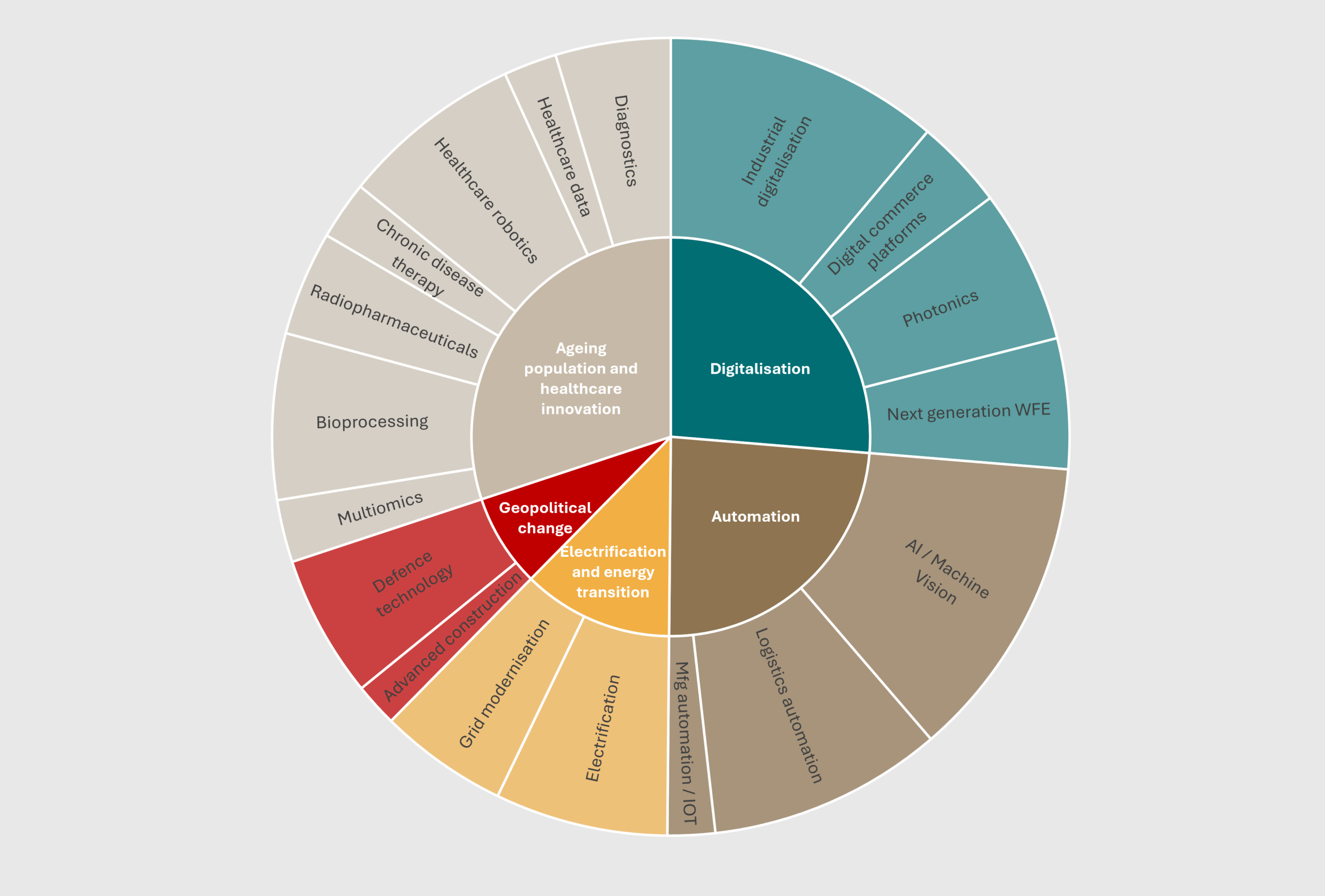
We see that some of the biggest structural changes in business and society demand innovative and often highly complex and technical solutions.

The transition of business and consumer activity into digital space demand specialist software and hardware tools for increasingly niche industry verticals.

Electrification of more areas of human activity, from vehicles to industrial applications to residential heating, again demands tailored solutions and specialist supply chains.

Decarbonisation and energy transition drives innovation in areas of material science and industrial equipment which are both specialist and complex in nature.  Not to mention the rapidly expanding perimeter of scientific discovery and innovation in life sciences and healthcare.

Investors should pursue these areas in a holistic way, across regions, sectors, and value chains.  In our view it is particularly beneficial to straddle different market segments – private companies, smaller companies as well as the larger listed companies – in researching this innovation and change.

Often companies at the earlier stage of their journey are closer to the innovation frontier in their industries, and conversations with their executives or founder-entrepreneurs can be    particularly insightful.

But sometimes the best place to apply those insights is somewhere else in the value chain, maybe in a stock with lower business risk and more optimal upside / downside trade-off that will generate returns in a more normalised macroeconomic environment.

This approach is integral to the Amati investment process, and we are looking forward to applying this informational and analytical advantage for the benefit of our clients in the global equity asset class.


* Lauren Cohen, Karl Diether, Christopher Malloy; The Review of Financial Studies, 2013. Tristan Fitzgerald , Benjamin Balsmeier , Lee Fleming , Gustavo Manso ; Management Science, 2020. David Hirshleifer, Po-Hsuan Hsu, Dongmei Li; The Review of Financial Studies, 2018. Kewei Hou, Po-Hsuan Hsu, Shiheng Wang, Akiko Watanabe, Yan Xu, Journal of Financial and Quantitative Analysis (JFQA), Forthcoming


Risk Warning

Past performance is not a reliable guide to future performance. The value of investments and the income from them may go down as well as up and investors may not get back the amount they originally invested. The return on investments in overseas markets may increase or decrease as a result of exchange rate movements. There may be occasions where there is an increased risk that a position in the Fund cannot be liquidated in a timely manner at a reasonable price. In extreme circumstances this may affect the ability of the Fund to meet redemption requests upon demand. Prospective investors should always read the Key Investor Information Document and the Prospectus, which contain full details of the costs and charges applicable to the Fund as well as specific risk warnings.


Insights

2 June 2026 - "Building the future"

The construction industry may appear low-tech, but the economic and demographic pressures are driving builders to innovate and digitise.

Following our participation in the Future Build, a building technology trade show, join Amati fund managers Graeme Bencke and Mikhail Zverev as they discuss how design software, modular building systems and construction site robots are transforming the industry.

We’ve also pulled together a short write-up on what we saw and how it feeds into the fund. Read the full article here.

19 May 2026 - "Auto semiconductors 2.0 - the new chapter(s) of growth"

Automotive semiconductors were once associated with electric vehicles theme, and their popularity rose and fell with the investor sentiment around EVs and self-driving cars. However, the opportunity set has now expanded to include new markets such as AI, industrial automation and robotics, while the original demand drivers are showing signs of life.

Join Amati fund managers Mikhail Zverev and Graeme Bencke to discuss what lies ahead for this niche but essential industry.

We’ve also pulled together a short write-up on what we saw and how it feeds into the fund. Read the full article here.

5 May 2026 - Notes from Hannover Messe

Packs of robot dogs, 3D printed shoes and self-assembling production lines. These are some of the innovations from Hannover Messe, one of the world’s largest industrial trade shows.

Join Amati fund managers Graeme Bencke and Mikhail Zverev as they discuss the leading edge of industrial technology and the implications for investors.

We’ve also pulled together a short write-up on what we saw and how it feeds into the fund. Read the full article here.

21 April 2026 - Defence technology update

Events in the Middle East once again focus investors’ minds on geopolitical and military challenges.  As defence spending rises worldwide, innovation is reshaping how nations protect themselves.

Join Amati fund managers Mikhail Zverev and Graeme Bencke as they explore the investment opportunities emerging across Space, Cyber and Drones.

7 April 2026 – “Genomics: the next chapter”

How falling sequencing costs are accelerating clinical adoption.

In this Amati Insights call, we discuss how advances in genomic sequencing are driving a new phase of adoption in healthcare, with important implications for diagnostics companies and investors.

24 March 2026 - "Robots don't call in sick: automation in logistics"

Higher labour costs and faster delivery times are driving more innovative solutions across the logistics supply chain — creating meaningful opportunities for investors.

Join Amati fund managers Mikhail Zverev and Graeme Bencke as they share insights from the UK’s leading automation event and highlight where they see the most compelling areas for future growth.

10 March 2026 - "Lab in the loop" and the acceleration in life sciences innovation

The cycle of innovation in life science research is accelerating as developments in molecular tools, automation and AI combine to reveal new treatment pathways, drugs and diagnostic biomarkers.

Join Amati managers Graeme Bencke and Mikhail Zverev as they consider the implications for the enablers of this innovation, from lab equipment to clinical trials to healthcare robotics.

24 February 2026 - Do androids dream of electric sheep? A pragmatic look at humanoid robotics and physical AI

One of the themes of the recent CES (consumer electronics show) was “physical AI”, a new term for robotics, including humanoid robots, where AI algorithms will train machines to perform real world tasks.

Join Amati managers Mikhail Zverev and Graeme Bencke as they take a look at what is happening today, what has yet to happen in the future and how investors can benefit without having to believe their wilder dreams.

10 February 2026 - Great software sell-off of 2026 - an "insane" buying opportunity?

The software sector experienced an indiscriminate sell-off in the past weeks, in some ways comparable to the dot-com crash and global financial crisis. Companies recently regarded as the best business models in the world are now perceived to be at existential risk from AI.

Join Amati managers Mikhail Zverev and Graeme Bencke as they discuss risks and opportunities that this sell-off presents to investors.

27 January 2026 - Memory super-cycle: from demand boom to critical shortages

Memory semiconductor companies have been a long-held position in the WS Amati Global Innovation fund. The recent demand boom and associated stock price rallies contributed strongly to the fund performance.

Join Graeme Bencke and Mikhail Zverev as they discuss what happens next and how they’re evolving their exposure to this increasingly mission critical part of the technology sector.

18 November 2025 - RFID 2.0: accelerating adoption

Recent conversations with the industry suggest that RFID and other wireless IoT technologies continue to unlock new transformative applications – from retail to healthcare to everyday consumer life.

Join Amati Global Innovation fund managers Mikhail Zverev and Graeme Bencke as they discuss how they are investing to benefit from what’s coming next.

4 November 2025 - Alzheimer’s Disease: diagnostics revolution

Alzheimer’s Disease is one of the most pressing unmet clinical needs and is a huge cost to healthcare systems and societies. Recent developments in Alzheimer’s diagnostics are nothing short of revolutionary and promise to unlock improved patient outcomes and valuable new markets.

Join Amati managers Mikhail Zverev and Graeme Bencke as they discuss how they pursue this opportunity in the WS Amati Global Innovation Fund.

21 October 2025 - Photonics and optical communications in the Age of AI

Photonics and optical communications have been key enablers of the digital revolution. With AI, the industry is entering a hyper-growth stage.

Join Amati managers Mikhail Zverev and Graeme Bencke to hear why the transition to optical data communication is inevitable and where they see investment opportunities benefiting from this technological change.

Portfolio

WS Amati Global Innovation Fund

As at 31st May 2026

Top 10 Holdings

10 Largest Holdings% of total assets
Samsung Electronics6.3%
MKS5.1%
Infineon Technologies4.4%
Basler3.6%
Allegro Microsystems3.4%
Impinj3.3%
Tecan Group3.3%
Lumentum3.1%
Dexcom2.9%
Bruker2.9%


Performance

WS Amati Global Innovation Fund

B Class

Performance


Cumulative Performance Table
as at 29/05/2026

Time periodFund Return
(%)
Benchmark Return**
(%)
1 month13.946.01
3 months12.847.26
6 months16.4511.39
1 year41.6530.33
2 years39.7639.84
3 years70.6668.20
Since launch*73.2778.00

* Since launch data is calculated from 23/05/2022.

** MSCI ACWI Index (GBP), Total Return. Past performance is not a guide to future performance.


Discrete Performance
as at 31st May 2026

Period 12 months toFund Return
(%)
Benchmark*
return (%)
31.05.202641.6530.33
31.05.2025-1.347.30
31.05.202422.1120.28

* MSCI ACWI Index (GBP), Total Return.

C Class

Performance


Cumulative Performance Table
as at 29/05/2026

Time periodFund Return
(%)
Benchmark Return**
(%)
1 month13.986.01
3 months12.997.26
6 months16.7511.39
1 year42.3630.33
Since launch*38.2536.48

* Since launch data is calculated from 24/06/2024.

** MSCI ACWI Index (GBP), Total Return. Past performance is not a guide to future performance.


Past performance is not a guide to future performance. Source – Waystone Management (UK) Limited and FE Fundinfo. Further details: Issued by Amati Global Investors Ltd., authorised and regulated by the Financial Conduct Authority. Registered in Scotland, number: SC199908. Registered address: 8 Coates Crescent, Edinburgh, EH3 7AL

How to Invest

WS Amati Global Innovation Fund is administered by Waystone Management (UK) Limited. Before investing you should view the relevant documents below.

For telephone dealing and enquiries please call:

Waystone Management (UK) Limited

Client Services and Dealing Line
T: +44 (0)345 922 0044
E: wtas-investorservices@waystone.com


Application Form

For further information regarding the application form, please visit Waystone’s website here.

FAQS

Please find below answers to some of the most frequently asked questions for WS Amati Global Innovation Fund. Should you wish to discuss another query, please contact us on 0131 503 9115 or email info@amatiglobal.com.

If you wish to apply for shares directly, please read the ‘How to Invest’ section and download the relevant application form.

Alternatively, you can also choose to invest in the platform of your choice. Please contact your platform directly to invest.


The WS Amati Global Innovation Fund is available on the majority of platforms. If your chosen platform does not currently hold the fund, please contact the relevant platform manager and ask that they contact us on 0131 503 9115 or email us on: info@amatiglobal.com

Daily at Midday.

T+4.

The minimum lump sum investment is £1,000.

The minimum lump sum top up is £500.

The minimum regular monthly investment is £50 per month.

As the WS Amati Investment Funds are intended for investors seeking long-term capital growth, all income arising within them is reinvested into the value of shares. In other words the shares are all accumulation shares. The annual income allocation date is 31 March and the interim income allocation date is 30 September.

MSCI ACWI Index (GBP) Total Return.